

Hidden Risks in “Natural” Supplements: The Silent Adulteration with Sildenafil, Tadalafil, and Vardenafil
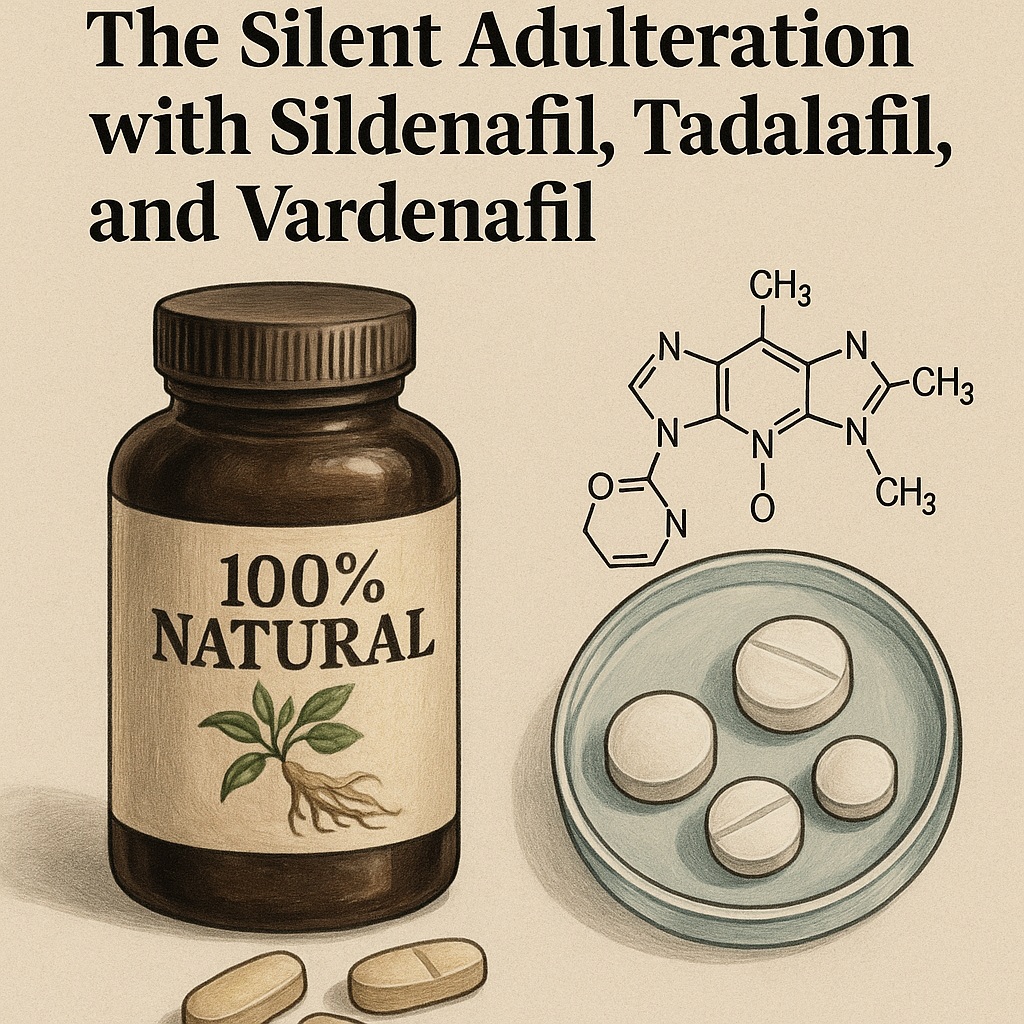
Introduction: When “Natural” Isn’t What It Seems
In the modern wellness market, the term “natural” has acquired an almost sacred status. Consumers searching for safe, herbal solutions to sensitive health problems—such as erectile dysfunction (ED)—are increasingly drawn to dietary supplements marketed as 100% natural and free from side effects. Unfortunately, behind the glossy labels and bold claims lies a troubling reality: a growing number of such products are adulterated with potent pharmaceutical ingredients like sildenafil, tadalafil, and vardenafil—the active compounds found in prescription drugs Viagra®, Cialis®, and Levitra®, respectively.
A 2022 analytical study by Petkova-Gueorguieva et al., published in the International Journal of Analytical Chemistry, exposed the alarming scale of this deception. Out of 20 dietary supplements marketed for male sexual enhancement, 14 (70%) contained undeclared pharmacologically active substances. The majority harbored sildenafil, often in dangerously high doses exceeding therapeutic recommendations. This finding represents not only a profound breach of consumer trust but a serious public health concern.
In this comprehensive article, we delve into the science, public health implications, and ethical quandaries surrounding this hidden adulteration. Beyond the chemistry and regulation, it is a story of how consumer vulnerability meets corporate opportunism—and why analytical vigilance is the only defense.
The Rise of the Supplement Industry: A Perfect Storm of Demand and Deception
Over the past two decades, the global dietary supplement market has grown into a multi-billion-dollar enterprise, projected to surpass $220 billion annually. The rise reflects both consumer health consciousness and the allure of “natural alternatives” to conventional pharmaceuticals. Erectile dysfunction supplements occupy a particularly lucrative niche, tapping into a condition that affects approximately 10% of men worldwide, with prevalence increasing with age.
Yet, this growing demand is coupled with weak regulation. Unlike pharmaceuticals, food supplements are not subject to mandatory premarket quality control or clinical testing. Manufacturers can market formulations with minimal oversight, provided they avoid explicit therapeutic claims. This regulatory gray zone has allowed some companies to add undeclared synthetic compounds to ensure efficacy—essentially transforming supplements into covert drug delivery systems.
In men reluctant to seek medical help for ED due to embarrassment or stigma, these “herbal enhancers” offer an illusion of discretion and safety. However, the consequences can be devastating: drug interactions, cardiac events, and unmonitored overdose are not uncommon among unsuspecting users.
The Pharmacological Triad: Sildenafil, Tadalafil, and Vardenafil
To understand why these undeclared substances are so problematic, one must first appreciate their pharmacology. Sildenafil, tadalafil, and vardenafil are selective phosphodiesterase type 5 (PDE5) inhibitors that facilitate penile erection by enhancing the nitric oxide (NO)–cGMP pathway, leading to smooth muscle relaxation and increased blood flow in the corpus cavernosum.
- Sildenafil (Viagra®): The first PDE5 inhibitor, typically prescribed in 50–100 mg doses. It has a half-life of about 4 hours and is contraindicated in patients taking nitrates or those with unstable cardiac disease.
- Tadalafil (Cialis®): Known for its long half-life (~17.5 hours), it is often dosed at 10–20 mg and allows for “weekend-long” efficacy.
- Vardenafil (Levitra®): Similar to sildenafil but with slightly higher selectivity for PDE5 and fewer visual disturbances.
When administered under medical supervision, these drugs are remarkably safe. The danger arises when they are ingested unknowingly or combined with other cardiovascular medications, which can trigger life-threatening hypotension or myocardial infarction. Thus, their clandestine inclusion in supplements crosses a clear ethical and legal line.
Analytical Forensics: Detecting the Hidden Compounds
The Bulgarian research team employed ultraperformance liquid chromatography (UPLC) coupled with photodiode array (PDA) and mass spectrometry (MS) detectors to analyze 20 commercial products purchased from pharmacies, online retailers, and social media vendors. Each sample underwent UV-spectral analysis and mass fragmentation profiling using ion trap MS detectors and was compared against reference standards of sildenafil, tadalafil, and vardenafil.
Their findings were sobering:
- 14 of 20 samples contained undeclared synthetic drugs.
- 12 products contained sildenafil, often in supratherapeutic doses up to 116.55 mg per tablet.
- 1 sample contained tadalafil (19.5 mg per capsule), equivalent to the full therapeutic dose of Cialis®.
- 1 sample contained propoxyphenyl thiosildenafil, a structural analogue of sildenafil never tested for human safety.
Even more concerning, the majority of products falsely claimed to be “100% herbal and natural,” and none disclosed any warnings regarding contraindications, drug interactions, or age restrictions.
The Case of Propoxyphenyl Thiosildenafil: A Chemical Deception
Among the most insidious findings was the detection of propoxyphenyl thiosildenafil—a chemically modified analogue of sildenafil. This compound differs slightly in structure but retains similar pharmacologic activity, designed to evade regulatory detection while preserving potency.
Such analogues are often synthesized in unregulated laboratories and have unknown toxicity profiles. They may interfere with liver metabolism, prolong QT intervals, or cause unpredictable cardiovascular reactions. The use of unapproved analogues represents a double deception—both concealing pharmaceutical ingredients and introducing untested molecules into human consumption.
In the analyzed sample, the compound was found in 25.5 mg per tablet, embedded within a supplement marketed as a “natural blend of ginseng, Gingko biloba, and Epimedium.” This is not merely mislabeling—it is a calculated fraud.
Public Health Ramifications: When Self-Medication Turns Deadly
The adulteration of dietary supplements is far from an isolated phenomenon. Between 2007 and 2014, the U.S. FDA reported 572 cases of supplements containing undeclared pharmaceutical ingredients, 42% of which were marketed for sexual enhancement. In Europe, similar investigations uncovered 929 contaminated products in the same period, and Brazilian authorities detected 180 illegal ED supplements out of nearly 3,000 tested.
The potential consequences are severe:
- Cardiovascular collapse from nitrate–PDE5 inhibitor interactions
- Hepatic and renal toxicity from untested analogues
- Neurological side effects, including vision and hearing loss
- Overdose and arrhythmia, particularly in elderly users or those with comorbidities
The study’s most alarming discovery was that some tablets contained up to 116.55 mg of sildenafil, exceeding the standard maximum dose of 100 mg. When combined with other supplements or alcohol, such doses could provoke acute hypotensive crises, particularly in older patients.
Regulatory Oversight: Global Gaps and Local Failures
The study also exposed regulatory fragmentation that enables this issue to persist. In Bulgaria, for instance, the Food Safety Agency lacks a digital reporting system for supplement-related adverse effects. The Bulgarian Drug Agency (BDA) only tracks adverse reactions from licensed pharmaceuticals, not supplements—creating a regulatory blind spot that manufacturers exploit.
This problem is not unique to Bulgaria. Across Europe and North America, supplements are regulated as food products, not drugs. This means no requirement for:
- Pre-market efficacy or safety testing
- Batch-to-batch quality assurance
- Disclosure of active pharmaceutical content
The result is a market where products adulterated with potent drugs can circulate freely until post hoc testing or adverse events force withdrawal. By the time a recall occurs, thousands of consumers may already be exposed.
The Analytical Data: Numbers that Tell a Disturbing Story
The laboratory data paint a strikingly quantitative portrait of deception:
- Sildenafil concentrations ranged from 2 mg to 116.55 mg per tablet.
- Tadalafil appeared in one sample at 19.5 mg, the full therapeutic dose.
- One sample contained an unidentified sildenafil analogue at 25.5 mg.
Out of 20 supplements:
- 70% contained undeclared pharmaceuticals.
- 90% lacked proper labeling in Bulgarian (violating national law).
- 100% claimed to be natural and free of side effects.
Many of these products were sold online with positive consumer reviews and marketing claims of “fast action” and “no side effects”, further compounding public misinformation.
The Psychology of Trust: Why Consumers Fall for “Natural” Claims
The appeal of herbal medicine lies not only in its tradition but in the psychological comfort it provides—the idea that “natural” equals safe. For conditions as sensitive as erectile dysfunction, this emotional dynamic intensifies. Shame and privacy concerns push many men away from clinical consultation and toward anonymous online solutions.
However, this trust is systematically abused. By associating synthetic drugs with herbal extracts, manufacturers exploit consumer expectations while masking pharmacological potency behind plant-based imagery. The irony is profound: men seeking to avoid pharmaceuticals may be ingesting more potent drugs than they would under medical supervision.
Analytical Chemistry as the Last Line of Defense
This study underscores the indispensable role of analytical chemistry in public health protection. Techniques like UPLC-PDA-MS, ion-trap mass spectrometry, and UV-spectral matching provide the resolution and specificity needed to identify adulterants even at trace concentrations.
Moreover, the use of reference retention times, UV maxima, and fragmentation patterns (m/z 447 for sildenafil, 302 for tadalafil) allows laboratories to confirm identities with forensic precision. Such analytical vigilance should become routine in supplement quality control, not a reactive measure following market scandals.
To ensure consumer safety, collaboration between regulators, analytical laboratories, and public health authorities is essential. Without it, the supplement industry risks devolving into a chemically unpredictable marketplace.
Toward Ethical and Regulatory Reform
Addressing this crisis requires more than laboratory vigilance—it demands structural change. Key recommendations include:
- Mandatory analytical screening of imported and domestically produced supplements before market release.
- Transparent online registries of verified and flagged products accessible to consumers.
- International data sharing between regulatory bodies such as the FDA, EMA, and WHO.
- Public education campaigns to demystify the term “natural” and emphasize the importance of medical consultation for ED.
The ethical burden extends to retailers as well. Online platforms and pharmacies must be held accountable for ensuring product authenticity. As the digital market expands, traceability systems using blockchain or QR-coded certificates could provide a verifiable chain of custody from manufacturer to consumer.
Conclusion: A Call for Transparency and Science-Based Vigilance
The analysis by Petkova-Gueorguieva and colleagues is more than an academic exercise—it is a warning. It reveals a health marketplace where consumer ignorance is weaponized, and science is the only shield.
The infiltration of sildenafil, tadalafil, and vardenafil—often in dangerous quantities—into dietary supplements represents a breach of both regulatory integrity and public trust. No supplement claiming to be “100% natural” should contain potent prescription drugs.
This issue sits at the intersection of ethics, chemistry, and commerce, demanding a global response rooted in transparency, analytical rigor, and informed consumer behavior. Until such reform is enacted, every “herbal enhancer” purchased online carries the shadow of pharmacologic uncertainty—and potentially, of harm.
FAQ
1. Why is it dangerous if a supplement contains undeclared sildenafil or tadalafil?
Because these drugs can interact with nitrates, antihypertensives, or cardiovascular conditions, leading to severe hypotension, heart attack, or stroke. When taken unknowingly, patients cannot manage dosage or monitor side effects.
2. Are sildenafil analogues like propoxyphenyl thiosildenafil legal or safe?
No. These analogues are unapproved chemical variants designed to evade detection. Their toxicity and pharmacokinetics are untested, posing unpredictable risks to liver, heart, and nervous system.
3. How can consumers protect themselves from adulterated supplements?
Purchase only from verified pharmacies or licensed manufacturers. Avoid products promising “instant results” or “100% natural potency.” Check regulatory databases such as the FDA’s Tainted Supplements list, and consult a healthcare professional before use.